Aperçu
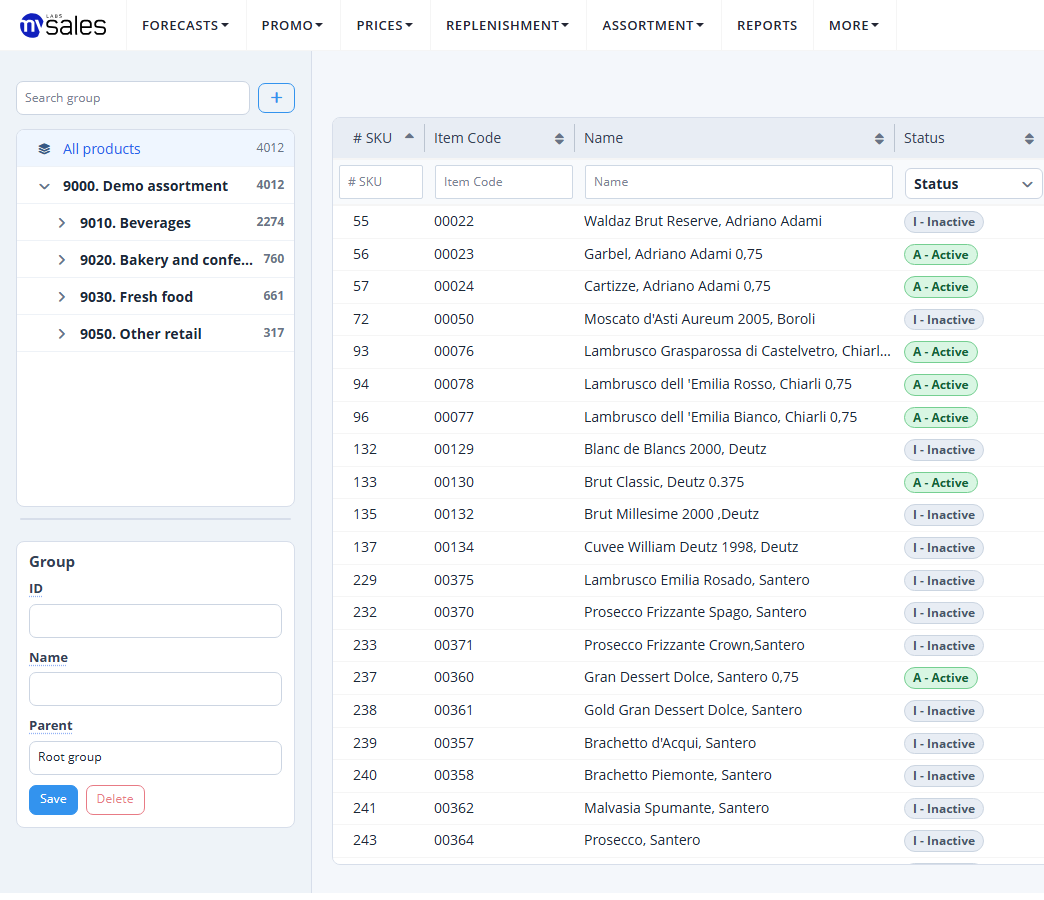
Écran des données produit
Modules MySales
Une couche opérationnelle maîtrisée pour les données produit, magasin, fournisseur et commerciales, afin que prévision, réapprovisionnement, prix, promotions et assortiment s'appuient sur des données propres.
Précision établie pour les produits référencés chez Drogas
Augmentation du chiffre d'affaires chez Chudo Market après déploiement
Réduction des démarques produits frais chez Blyzenko
Une plateforme IA relie les prévisions, le réapprovisionnement, les prix et les promos — les signaux circulent automatiquement entre les modules, synchronisant commandes, prix et campagnes en permanence.
La planification retail dépend de données de référence fiables.
Lorsque les attributs SKU, groupes, marques, fournisseurs, unités de mesure, règles fiscales, durées de vie ou liens magasins sont incomplets ou incohérents, les décisions automatisées héritent de ces erreurs.
MySales traite la gestion des données de référence comme un processus gouverné, pas comme un simple annuaire.
Les équipes peuvent maintenir les référentiels, examiner les champs sources et valider les changements avant qu'ils n'affectent les processus aval.
Maintenez les fiches SKU avec les attributs opérationnels: code article, nom, statut, capacité, unité de mesure, pays, fabricant, marque, TVA, durée de vie et historique des mises à jour.
Gérez les groupes, sous-groupes et arbres de catégories avec le nombre de SKU, des vues par magasin ou branche, et une responsabilité claire sur les changements de hiérarchie.
Repérez les attributs manquants, doublons ou contradictoires avant qu'ils ne perturbent prévision, réapprovisionnement, assortiment, prix ou promotions.
Standardisez fabricants, marques, pays, magasins, fournisseurs et autres listes de référence pour que les équipes travaillent avec un vocabulaire contrôlé.
Suivez quand les fiches ont été mises à jour, qui les a modifiées et quels champs sources alimentent chaque processus de planification.
La gestion des données de référence améliore la qualité de chaque module MySales en réduisant le travail caché de nettoyage derrière les décisions de planification.
Un flux MDM typique commence par la synchronisation avec les systèmes sources, puis passe par une revue métier contrôlée.
Importez les données produits, magasins, fournisseurs, marques et catégories depuis ERP, POS, WMS et systèmes commerciaux.
Mappez les champs sources vers les référentiels et hiérarchies produit MySales.
Signalez les fiches incomplètes, dupliquées, inactives ou contradictoires.
Permettez aux utilisateurs autorisés de revoir et mettre à jour les attributs dans des flux contrôlés.
Publiez les données validées vers prévision, réapprovisionnement, prix, promotions et assortiment.
Le module fonctionne au mieux lorsqu'il est connecté aux systèmes qui détiennent les données de référence retail.
MySales peut exposer le contexte technique des champs aux utilisateurs métier tout en conservant la traçabilité source pour l'IT et les équipes data.
La gestion des données de référence renforce tout le socle décisionnel MySales.